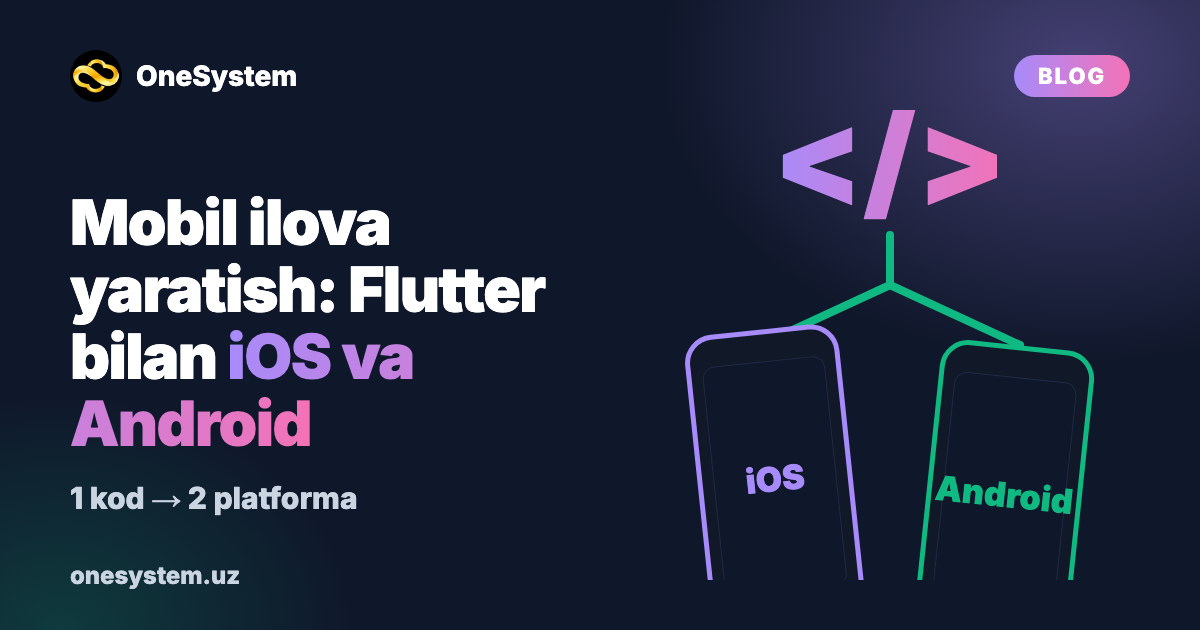
Mobile App Development: One Team Builds iOS and Android with Flutter
Every business owner who starts thinking about a mobile app soon runs into the same question: "Do I need one app for iPhone and a separate one for Android?" In the past the answer was usually "yes": two programs, two teams, two update cycles. Today, for many projects, there is another way — Flutter.
In this article we explain, without technical jargon, what Flutter is, what it gives a business, when it is the best choice and when you should consider something else. At the end you'll find the stages of app development and answers to common questions.
This is not a price list. Every app is different, so we work out cost and timeline in a free consultation. We have a separate article on what drives the price (see the links below).
The two-platform problem: why it matters
Some of your customers use iPhones, others use Android. If your app is only on one platform, you lose part of your audience. The traditional way to be on both is to build two separate apps:
- one programming language and one team for iOS;
- another language and another team for Android;
- every new feature is written and tested twice;
- the two apps drift apart: a button exists in one but not yet in the other.
The result: more time, higher costs and slower updates. For small and medium businesses this often ends with "let's postpone the app."
What Flutter is, in plain words
Flutter is an open-source toolkit (framework) for building apps, created by Google. Its core idea is simple: you write one codebase, and it produces both an iOS app and an Android app.
Imagine building the same house in two cities from one blueprint. One blueprint, one crew, a result in two places. Flutter works the same way for software.
Key points:
- One codebase. Business logic, screens and design are written once.
- Its own interface. Flutter draws the screen itself, so the app looks the same on iPhone and Android and keeps your brand design exactly as intended.
- Fast development. Developers see changes on screen almost instantly ("hot reload"), which speeds up design work and fixes.
- Phone features. Camera, location, notifications, payments and more are connected through dedicated libraries.
What it means for your business
What matters is the outcome, not the technical details. Flutter gives a business:
- One team, one process. You talk to one team, not two. Each task is explained and approved once.
- Both platforms at the same time. The app launches on iOS and Android together — no customer has to hear "not available yet."
- Faster updates. A new feature is written once and arrives in both apps.
- A consistent experience. Whatever phone your customer uses, the app looks and works the same. That matters for your brand.
- Easy to grow. It's convenient to launch a minimum viable product (MVP) first and add features step by step.
Note that "one codebase" does not mean "half the price." Each platform's settings, store requirements (App Store, Google Play) and testing still need separate work. But the core work is done once — and that simplifies the whole process.
When Flutter is the best choice
Flutter works especially well for:
- Business apps: ordering, catalogs, bookings, customer accounts, bonuses and loyalty programs.
- Service apps: delivery, booking places (for example, sports pitches), queues and appointments.
- Internal tools: apps for staff, sales agents and couriers, the mobile side of a CRM or warehouse system.
- Startups and MVPs: when an idea needs to be tested quickly.
- Content and reference apps: maps, guides, catalogs, learning materials.
Our portfolio includes mobile projects such as Metro Map (the Tashkent metro: map, routes and travel time, places near each station), the sports-pitch booking app O'ynaa and the personal finance app BarakaFin. You can see all of them on our portfolio page.
When to consider another path
The honest answer: Flutter is not always the right choice.
- For heavy graphics and 3D games, dedicated game engines are a better fit.
- For apps that depend heavily on the newest platform-specific features, native (separate) development is sometimes better.
- You may not need an app at all. If your customers are already on Telegram, a Telegram bot or mini app is often faster and more affordable. If your main goal is to be found on Google, you need a website first.
That's why we start the consultation with the task, not the technology: what will your customer do in the app, and how often will they come back?
App development stages
Even with Flutter, building an app follows clear stages:
- Consultation and goals. Who the app is for, what problem it solves, which features come first. Our consultation is free.
- Structure and project brief. List of screens, user journey, whether an admin panel is needed, which systems to connect (payments, CRM, warehouse).
- Design (UI/UX). A sketch first, then the full design. You review and comment.
- Development. The Flutter app, the server side and the admin panel.
- Testing. On different phones, on iOS and Android, in real-life scenarios.
- Store release. Preparing for App Store and Google Play requirements and passing review.
- Support. Monitoring, fixes and new features.
What affects timeline and cost
To give an exact figure, we need to see the project. The main factors are:
- Number and complexity of features (payments, maps, chat, notifications);
- Admin panel and its capabilities;
- Integrations (payment system, CRM, 1C, warehouse);
- Design — a ready-made style or fully custom;
- Number of languages — Uzbek, Russian, English;
- Store release and ongoing support.
The most practical approach is to start with a minimum version: launch with 2–3 core features and grow the app based on customer feedback. That way your budget goes into what you actually need.
Before you order an app: 5 questions to ask
Whichever team you work with, ask these before you start:
- Who will own the code and the store accounts? They should be in your name.
- Is there an admin panel? Can you change prices, products and texts without a developer?
- How is testing done? On which phones and in which scenarios?
- Who handles the store release? Who is responsible for App Store and Google Play requirements and review?
- What happens after launch? How quickly are bugs fixed and how are new features added?
Clear answers to these questions prevent most misunderstandings before the project even begins.
Frequently asked questions
Are Flutter apps slow? No — in typical business apps users won't notice any difference. A Flutter app runs directly on the phone. Specialised solutions may be better only for heavy graphics and 3D games.
Will the app be on the App Store and Google Play? Yes. Separate apps for both stores are built from one codebase, and each goes through its own review. We manage this process.
Can features be added later? Yes. In a well-built app, new screens and features can be added later — and they arrive on both platforms at once.
Do I also need a website or a bot? Often, yes. A website brings new customers from Google, a bot serves customers on Telegram, and an app keeps your regular customers engaged. When one team builds all of them, they work together smoothly.
How much does mobile app development cost? The cost depends on features, design, integrations and support. We'll review your project and give you a price in a free consultation.
Summary
Flutter lets you work with one team and one codebase instead of two separate apps for iOS and Android. For most business apps that means a faster launch, simpler updates and the same experience for every customer. But technology comes second: first, define the problem your app should solve.
Get your app's cost and timeline in a free consultation
Tell us about your idea: whether you need an app or a bot or website is enough — we'll decide together and estimate the timeline and cost for your project.
- 💬 Telegram: t.me/OneSystem_uz
- 📞 +998 91 121 90 15
- 🌐 onesystem.uz
Useful links:
- Mobile app development service: /services/mobil-ilova
- Our work: /portfolio
- Does your business need a mobile app? 7 signs: /blog/biznesingizga-mobil-ilova-kerakmi-mana-7-ta-aniq-belgi
- Mobile app cost and timeline: /blog/mobil-ilova-yaratish-narxi-2026-toliq-qollanma-va-muddatlar
- Launching a startup: from idea to MVP: /blog/startupni-ishga-tushirish-goyadan-mvp-va-biznesgacha