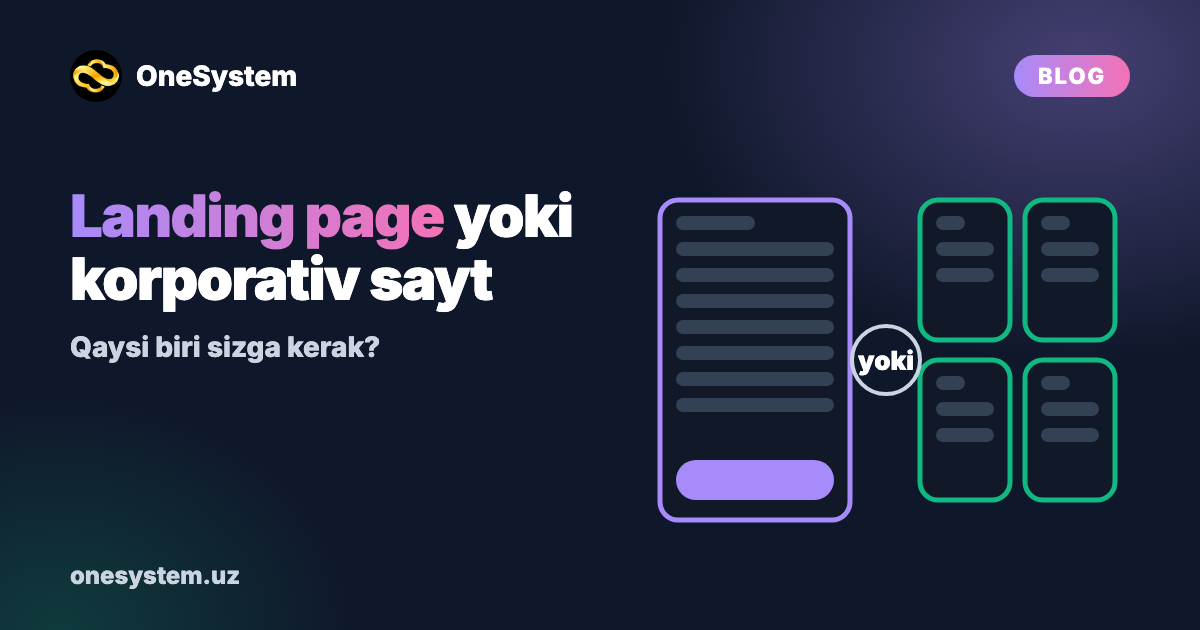
Landing Page or Corporate Website: Which One Do You Need?
Behind the request "we need a website" there are often two different needs. One is to sell a single offer quickly. The other is to present the whole company and earn trust. A landing page suits the first; a corporate website suits the second. The wrong choice leads either to wasted money or to results that never arrive.
In this article we explain the difference in plain words, give a recommendation for 5 typical situations and show how the two can be combined.
This is not a price list. Every project is different, so we work out cost and timeline in a free consultation.
What a landing page is
A landing page is a one-page website with a single goal. It usually presents one product, service or promotion and leads the visitor to one action: submit a request, call, or sign up.
A typical structure:
- A strong headline and offer;
- The problem and the solution;
- Benefits and results;
- Trust: customer reviews, case studies, certificates;
- Questions and answers;
- A request form or CTA button.
Strength: quick to build and very effective for advertising — visitors aren't distracted. Limitation: hard to rank on Google for many searches, and it doesn't show the company as a whole.
For example, OS Fitnes in our portfolio is a landing page for a fitness business.
What a corporate website is
A corporate website is the company's full "digital office". It has several pages: about the company, services (each on its own page), portfolio or catalog, blog and contacts.
Strength: builds trust; each service page can rank on Google for its own search; a blog brings long-term SEO traffic. Limitation: takes more time and content to build and needs regular updates.
For example, AIRIUM (an HVAC equipment catalog) and YARIZ (a polymer pipe manufacturer's site) fully present their products and services.
Quick comparison
Landing pageCorporate website Pages1Several GoalOne offer, one actionPresent the whole company Build timeFasterLonger For advertisingExcellentGood, but each service needs its own page On Google (SEO)LimitedStrong: many pages, a blog TrustFor one productFor the whole company UpdatesRareRegular5 situations: what to choose
1. You want to test a new service or promotion quickly
Landing page. Launch fast, turn on ads and see whether requests come in. If results are good, expand later.
2. You have one main product and sell through advertising
Landing page — a complete one, with reviews and a Q&A block. For ad traffic, one clear page works best.
3. Several services and B2B clients
Corporate website. Partners and large clients check a company: who you are, what you've done, who you've worked with. One page can't build that trust.
4. You need a steady flow of customers from Google
Corporate website + blog. Each service page and article can rank for its own search. From our own experience: in July 2026, through its service pages and blog, onesystem.uz reached first place on Google for the Uzbek searches "mobil ilova yaratish" (mobile app development) and "telegram bot yaratish" (Telegram bot development), with no ads. Rankings change, so the pages and blog are updated continuously.
5. International clients and multiple languages
Corporate website, set up separately for each language. For example, the Triptonia tourism website works in 6 languages and is configured for Google separately in each.
You can combine them
In many cases the best solution is both together:
- a main corporate website — for trust and SEO;
- a separate landing page for each ad campaign or promotion — inside the same site or at its own address.
That way ad traffic lands on a clear offer, while visitors from Google see the whole company. When one team builds both, design, admin panel and lead handling are shared.
6 signs of a good landing page
- A clear offer on the first screen: what you offer and to whom — clear within 3 seconds.
- One main action: "Submit a request" or "Call us". Several different buttons distract.
- Trust elements: real customer reviews, completed work, a short note about the team or company.
- A short form: only the fields you need — name and phone are often enough.
- Fast loading on phones: most ad visitors arrive on mobile.
- Fast lead delivery: the form goes straight to Telegram or your CRM, so you can reply quickly.
Minimum pages for a corporate website
You don't have to start big. For many businesses, this is enough to begin:
- Home page — who you are and your main services;
- A separate page for each main service — to rank on Google for each search;
- Completed work or catalog — for trust;
- About us — team, experience, address;
- Contacts — phone, Telegram, map and a request form;
- Blog — for SEO; can be added later once content is ready.
Other pages are added as the business grows.
Common mistakes
- Putting everything on one landing page. When several services are mixed on one page, visitors don't know what to request.
- Turning a corporate site into a "shop window". The site looks nice, but pages have no clear CTA or form — visitors leave.
- Sending ads to the home page. An ad for a specific offer should lead to a specific landing page.
- Not checking the mobile version. Many visitors come from phones; a site that's awkward on mobile loses leads.
4 questions before you decide
- Where do your main customers come from: ads or Google search?
- How many services or products do you need to show?
- How carefully do customers check you before buying? (a small purchase — a little; a large contract — a lot)
- Who will update the content, and how often?
The answers often point to the choice on their own.
Frequently asked questions
How long does a landing page take? Usually less than a corporate website. The exact time depends on the number of blocks, the design and how ready your copy is.
Can a landing page become a corporate website later? Yes. New pages can be added to a well-built landing page to grow it into a corporate site.
Does a landing page rank on Google? It can, but usually only for a few searches. For steady traffic across many searches, you need a multi-page site and a blog.
Which is cheaper? Usually a landing page, as the scope is smaller. But the price depends on design, features and integrations — we'll work it out in a free consultation.
Does a landing page need its own domain? Not necessarily. It can be a separate page inside your main site (for example, onesystem.uz/aksiya). A separate domain is usually chosen for a separate brand or a large campaign.
Can it connect to a Telegram bot? Yes. The request form can be set up so that leads go straight to Telegram or your CRM.
Summary
A landing page is for selling one offer quickly. A corporate website is for presenting the whole company, building trust and ranking on Google. For many businesses the strongest option is a corporate website plus separate landing pages for campaigns. If you're not sure where to start, look at where your customers come from — the answer is there.
Find out which one you need in a free consultation
Tell us about your business and customers: together we'll choose a landing page, a corporate website or both, and estimate the cost and timeline for your project.
- 💬 Telegram: t.me/OneSystem_uz
- 📞 +998 91 121 90 15
- 🌐 onesystem.uz
Useful links:
- Website development: /services/sayt-yaratish
- Our work: /portfolio
- Landing page development: /blog/landing-page-yaratish-7-kunda-sotuvga-tayyor-sayt